

The Scugnizzo Cup
Born in lockdown inside a former juvenile prison, Naples' unique football tournament has become something much bigger than the game.

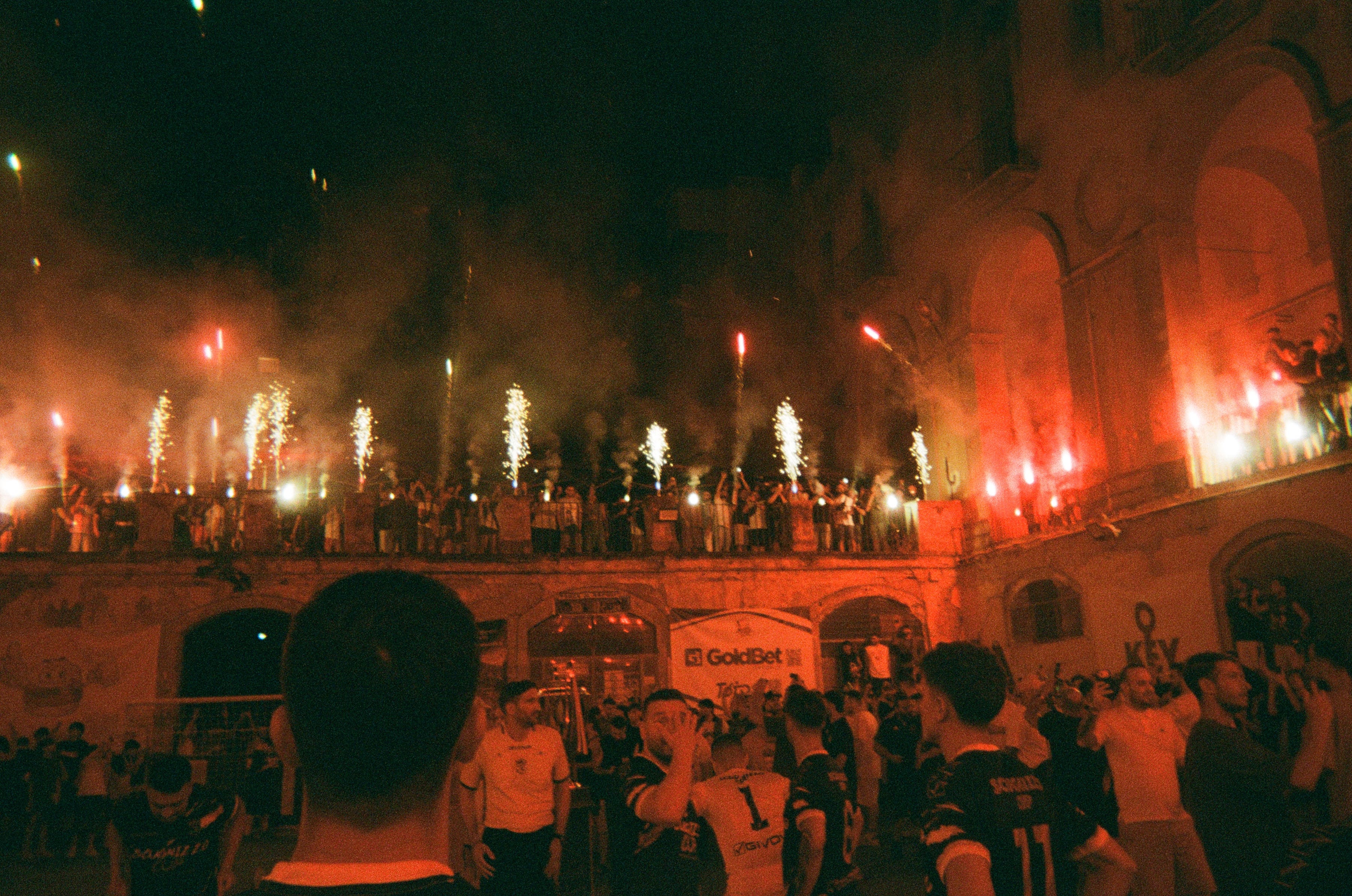
It starts with a bang. Red fireworks illuminate the courtyard and within seconds the air is thick with smoke, reducing players to silhouettes while the crowd on the balconies above disappear into a crimson haze. Somewhere in the middle of it all the players are warming up, stretching, knocking a ball back and forth to get a feel for it, the goalkeeper making himself as big as possible in the square goal. The walls around us are a few storeys of crumbling, weather-beaten stone, windows and archways packed with bodies, banners hanging where prison bars once were. This is the final of the Scugnizzo Cup, held inside a former juvenile detention centre in the heart of Naples, and it looks like nothing else in football.
The Filangieri Institute held young offenders for over 100 years, before that it was a convent. For the last decade it has been the Scugnizzo Liberato, a reclaimed community space offering education, cultural activities and mutual aid. Its courtyard, where inmates once exercised, is now a futsal pitch, painted with the tournament’s name and a huge mural celebrating SSC Napoli’s 4th Scudetto trophy. The pitch even appeared in SSC Napoli’s kit-launch video this summer.


Fittingly - given the building’s history - the Scugnizzo Cup started with an act of youthful defiance.
During the height of COVID restrictions in 2020, the streets of one of Europe’s most social cities had fallen unnaturally quiet, and a group of friends wanted to play football. They chose to play in the Scugnizzo Liberato because it offered cover from the authorities. What they didn’t expect was who would be watching.
“As we played, we realised that the people from our neighbourhood were cheering us on,” recalls Giuseppe Pipino, one of the tournament’s founders. “So we thought we’d gather friends and people from the neighbourhoods below.”
Even under a lockdown, the buzz was immediate. Giuseppe and co-founder Luca Borrelli had to negotiate with Naples City Hall for permits, masks, hand sanitiser and other COVID supplies just to invite a small crowd. In the first edition the teams were made up of friends, workmates and people they knew from football. Each one represented a neighbourhood. And in a city where football exists everywhere you look, each game felt like an event.
Now the tournament is in its 7th edition and a lot has changed. The games are live-streamed and hosted on YouTube. The players come from across Europe and South America, many of them professionals. There are sponsors, speakers, floodlights and fireworks. But perhaps most significantly, there is no social distancing here anymore. The Scugnizzo Liberato is packed from start to finish, with generations of Neapolitans squeezing shoulder-to-shoulder into the building, jostling for position or clambering up to the balconies to get the best view. The bars are busy, caterers sling out plates of tomato gnocchi and the boundaries between player and spectator barely exist.
When a goal is scored, they disappear completely.


Fans and teammates alike pour onto the pitch to celebrate and the whole place descends into pure chaos for a few minutes until the referees and organisers manage to restore order. It’s the kind of joyous release that can only come from an atmosphere as tense and oppressive as the one you find here.
“In Naples, as we know, there’s a shortage of jobs, average wages are low, and it’s a city that faces problems but never loses the desire to solve them and make things better,” says Giuseppe. “[The Scugnizzo Cup] has become a gathering place where less affluent families have found a way to take their minds off their own problems”.
Local photographer Ciro Silvestre arrived thinking he was going to document a football tournament, but it wasn’t until he put his camera down for a moment and observed what was going on around him that the experience made sense. “The match almost became secondary,” he tells me, “I was looking at grandparents, children, teenagers and entire families sharing the same space with genuine happiness. That was when I understood this was not simply a football tournament. It was a celebration of a community”. He remarks that despite the rapid growth of the tournament, the locals still feel like it belongs to all of them, saying “that kind of connection only happens when something grows without losing its original spirit.”


To fully understand why this tournament means so much to local people, you need to understand what a scugnizzo is.
The word is Neapolitan dialect, sometimes used in a derogatory way, for the street kids from the city’s poorer quarters. In its past life, the Filangieri Institute used to lock them up, now as the Scugnizzo Liberato centre it sets them free.
“To think that once upon a time, on that field, there were suffering young people serving their sentences” says Giuseppe Pipino, “and now to see it filled with young people striving for a future. It is something inexplicable.”
Giuseppe doesn’t use the word scugnizzo as an insult, but rather to describe one of the city’s most beloved figures.
“Soccer in Naples has immense power — that’s why we revere Maradona so much,” he tells me, “because he embodies the true scugnizzo. Born into poverty and hardship, yet thanks to a soccer ball, he managed to break all the chains of negativity that surrounded him and reach the pinnacle of the world.”
Describing Maradona as a deity in Naples isn’t an exaggeration, in fact it’s probably the only appropriate word to use. Turn any street corner in the city and there’s a 50/50 chance you’ll see a shrine to Santa Maria, or to Diego Maradona.
”Naples and the Neapolitans see so much of themselves in Diego,” Giuseppe tells me, “because one day they hope that, with a soccer ball, they too can change their lives and overcome the hardships that Naples presents to them”. It’s no surprise to see that Maradona’s image is very visible throughout the tournament. His name is printed across SSC Napoli shirts of any generation, sitting above the famous number 10. His image is plastered across walls as street art, or tattooed on thighs, calves and forearms.


Among all of the noise, passion, fireworks and smoke of the tournament’s final, the fans were also treated to an incredible match. Bayern Monaco took on Galatasaray, both named after famous teams to match the colours of their jerseys, and featuring some of this edition’s outstanding players. Galatasaray’s Lamas would win awards for the tournament’s best player and best goal, while Bayern Monaco’s Fuschino picked up best goalkeeper and best save. Also playing was Scugnizzo Cup legend Claudio Virenti - a tournament mainstay and the only player to have played in every edition since its beginning. “We could call him the true GOAT for the consistency and passion he brings to the Scugnizzo Cup” says Giuseppe. A bold claim, but backed up on the night as Virenti picked up another winner’s medal for Galatasaray.
After taking an early lead in a frantic start to the match, Bayern Monaco eventually trailed 5-4 to Galatasaray in the dying minutes of the match. In an inspired move, Bayern Monaco substituted their goalkeeper, with their pivot Marcelinho taking over in goal, flipping his shirt inside out to differentiate himself from the rest of his team and playing a goalkeeper-cum-striker role requiring incredible stamina. The switch paid dividends as Marcelinho was involved in Jorginho’s equalising goal which sent the match to penalties.
The improvisation and unorthodox tactics are all part of the experience here. “What makes the tournament special is the atmosphere, the environment and the flair,” says Marcelinho, reflecting on the game. “Like street football. That’s the difference from other tournaments, and when we step onto the pitch the tournament becomes special.”
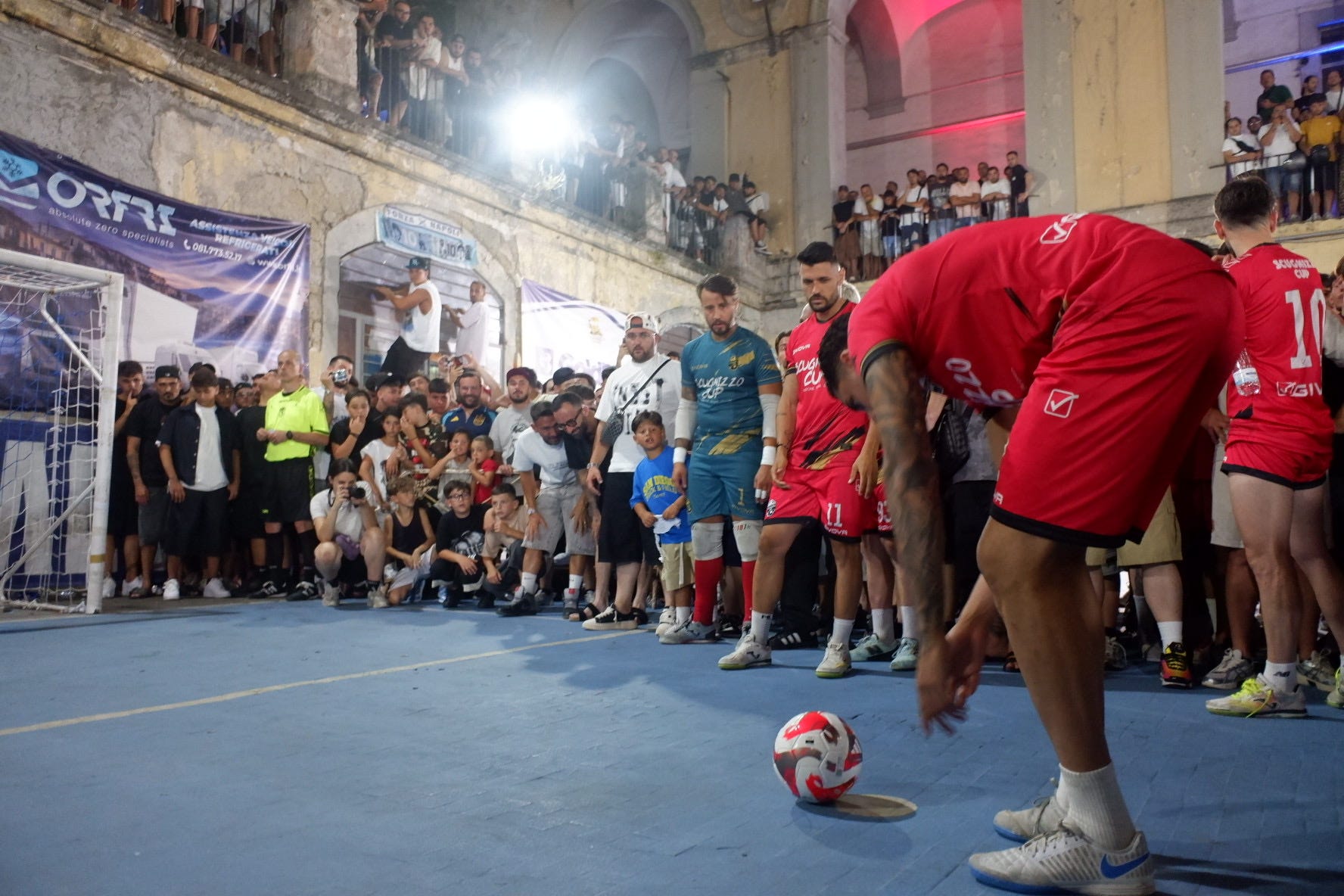
Often in football, the walk to take a penalty in a shootout is the loneliest experience imaginable. At the Scugnizzo Cup, players have to fight through the crowds to get to the penalty spot, a thousand eyes on you from centimetres away. Galatasaray manage to hold their nerve and convert all of their penalties, while Bayern Monaco miss two. Immediately their goalkeeper is absorbed into a pulsating crowd of bodies, of cheers, of players and fans. Immediately, boxes of fireworks comically labelled “BOOM” are loaded onto the pitch and set off. The Scugnizzo Cup is over and Galatasaray are champions for this year at least.
Marcelinho is already thinking about next year. “It was my first time and I was lucky enough to go straight to the final” he says “it was a fantastic and beautiful experience, but next time I want to win!”
Despite the defeat, Marcelinho is full of praise for the tournament and its organisers. “The tournament is organized brilliantly, both on the pitch and on social media,” he tells me, “it’s unique and special - I’ll remember it forever.”


But for all the spectacle of the final and the penalties, the smoke and the fireworks, the Scugnizzo Cup’s real purpose is much closer to home. “Even those who can’t afford to enrol their children in soccer schools can come to the Scugnizzo Cup,” Giuseppe tells me, “where people - without asking for money - help children have fun playing with a soccer ball.” After the fireworks have died down and some of the crowd starts to file out, it’s the local kids who claim the pitch as their own, chasing a ball around and cheering their own goals like they did for the tournament’s players earlier. The Scugnizzo Liberato hosts football training sessions to give young people a space to play and practice, something that many have said is disappearing from Naples and other cities.
Having spent the evening photographing the crowds more than the match, Ciro Silvestre has no doubt what the Scugnizzo Cup means to the people of Naples now. “It’s not only about football,” he explains, “it was about giving young people their streets back and reminding everyone that public spaces belong to the community”.
It’s about 1am in Naples and the noise from the Scugnizzo Liberato is audible streets away. The walls are the same, but everything inside of them has changed. Tonight, the streets belong to the Scugnizzo once again.


Words and photos - Paul Gibbins